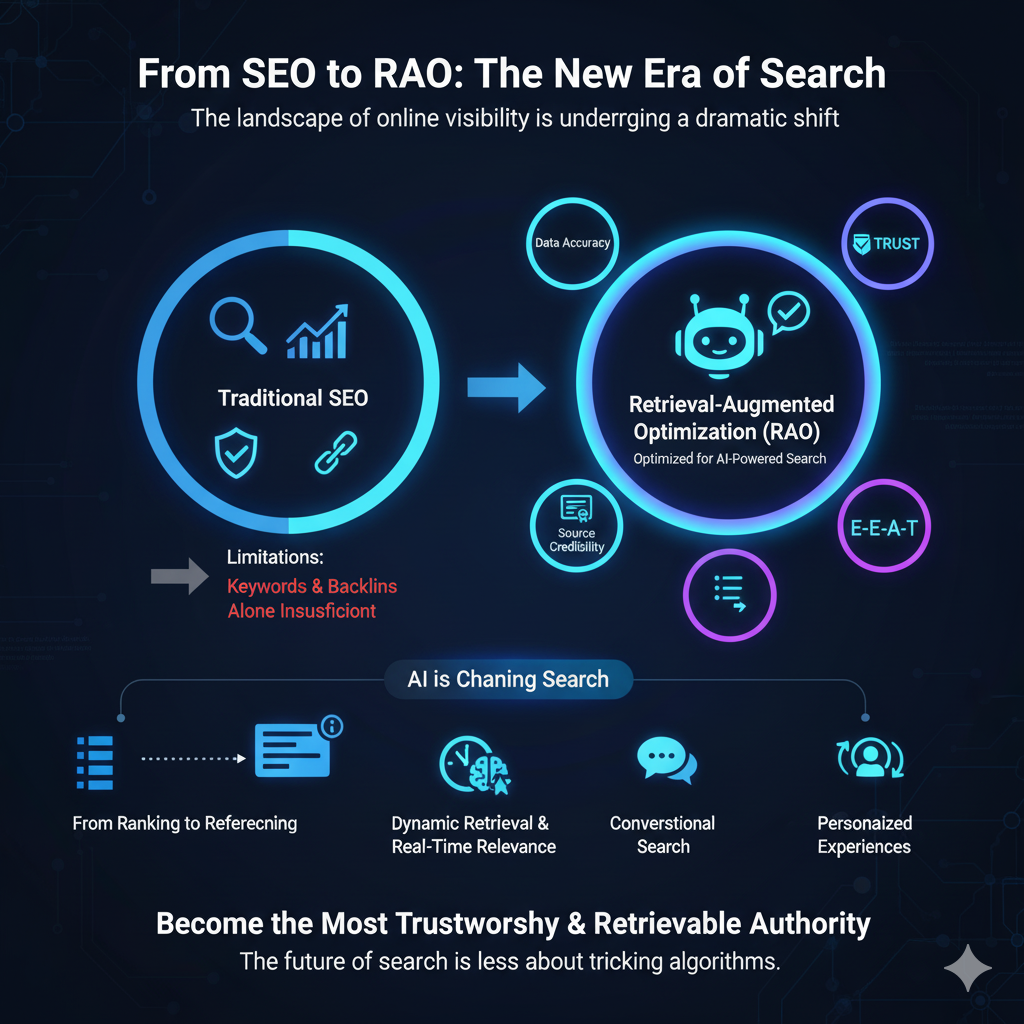
From SEO to RAO: The New Era of Google Search
The landscape of online visibility is undergoing a dramatic shift. The world of online search is undergoing a fundamental shift. For years, the goal of SEO was to "rank" on the first page of results. But with the rise of AI-powered search, the game is changing. Now, the goal is to become a trusted, retrievable authority, and more sophisticated approach and strategy known as Retrieval-Augmented Optimization (RAO) is emerging.
What Is RAO and Why It’s Taking Over?
RAO is a strategy that optimizes content for AI-powered search assistants rather than traditional search engines. Unlike search engines that rely on indexing and ranking a list of links, AI assistants like ChatGPT, Gemini, and Perplexity AI retrieve information from numerous sources and synthesize a single, concise answer. Users are no longer sifting through ten blue links: they're getting a direct, curated response. This fundamental change in user behaviours is why content must now be optimized for AI retrieval.
The Limitations of Traditional SEO
While SEO is not dead, it is no longer the finish line. The traditional focus on keywords and backlinks alone is insufficient in the era of AI-driven search. AI assistants are trained to prioritize certain qualities that traditional SEO often overlooks. A brand-new set of criteria for content success has emerged:
§ Data Accuracy: AI models are designed to find and present the most accurate information. If your content contains outdated or incorrect data, it will not be surfaced.
§ Source Credibility: AI assistants prioritize content from authoritative, trustworthy sources. Just as Google's E-E-A-T (Experience, Expertise, Authoritativeness, and Trustworthiness) guidelines have always been important, they are now essential for being included in an AI-generated response.
§ Structured Clarity: AI models can process and learn from well-organized content far more easily. Content that is clear, concise, and logically structured is more likely to be retrieved.
From SEO to RAO: How AI is Changing Search
§ From Ranking to Referencing: Instead of trying to get your website to the top of a static list of links, your new goal is to have your content cited as a trusted source within an AI-generated response. While your brand might not appear on a traditional top 10 list, it could be directly referenced as the source of a factual answer, which is far more powerful.
§ Dynamic Retrieval and Real-Time Relevance: Traditional search relies on static ranking signals. But RAO-optimized content is pulled in real time based on the user's context and intent. This means your content's relevance isn't just about keywords, it’s about how well it fits into the immediate needs of a conversational query.
§ The Rise of Conversational Search: AI-powered search is all about dialogue. The future of search isn't just about typing in a query; it’s about speaking or asking a question. RAO prioritizes dialogue-friendly answers over keyword-stuffed content, making it crucial to write in a way that is clear and easy to understand for both humans and AI models.
§ Personalized Experiences: The days of one-size-fits-all search results are fading. RAO systems are able to factor in a user's personal history, preferences, and past searches. This means the same question might produce different, highly personalized answers for different users, making the content's relevance even more important.
The future of search is less about tricking algorithms and more about becoming the most trustworthy and retrievable authority in your field.
To know details about key strategies for advanced RAO; how to ensure content is discoverable by AI bots, how to ensure content is cited by AI in response to speech queries, key techniques, how RAO being used in different industries, examples and strategies in practice, the intersection of SEO and RAO watch out for our forthcoming book: "SEO Mastery Playbook" by Karminder Ghuman and Raj Santra
#SEO #SEOStrategy #SEOTips #GoogleRanking #SearchEngineOptimization #LinkBuilding #TechnicalSEO #KeywordResearch #LocalSEO #SERP #GoogleAds #SEOCourse #SGE #RAO