Digital Marketing: What it really is?
Digital Marketing refers to leveraging digital channels such as search engines, social media, email, websites, and online ads to promote brands, engage audiences, and drive conversions.
It has evolved from a niche strategy into a dominant force shaping how businesses reach consumers.
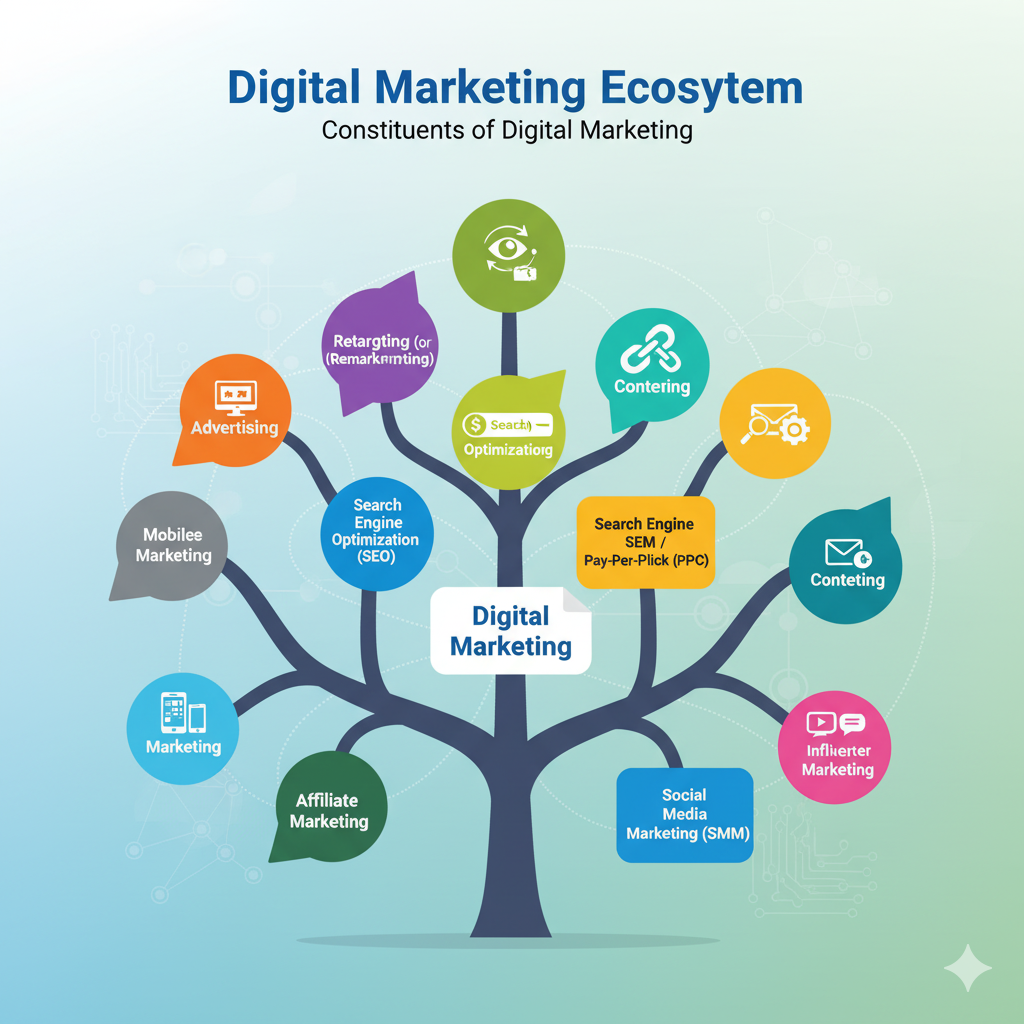
Digital Marketing Ecosystem: Constituents of Digital Marketing
Digital Marketing is a broad discipline made up of several interconnected constituents (channels + strategies) that work together to build visibility, attract customers, and drive conversions. Here’s a detailed breakdown:
1. Display Advertising: It is the use of visual advertisements, such as banner ads, images, video, and rich media, that are placed on third-party websites, apps, and social media platforms. The primary Goal is to increase brand awareness (top of the funnel) and to drive traffic, clicks, or conversions. These ads are part of a network (like the Google Display Network) that allows advertisers to target users based on demographics, interests, or the content of the website they are browsing (contextual targeting). The format for display advertising typically includes static or animated graphics, along with a text headline and a call-to-action (CTA) button.
2. Retargeting (or Remarketing): It is a specific and highly effective form of display advertising designed to re-engage users who have previously visited a company's website or interacted with the brand but left without completing a desired action (e.g., making a purchase, signing up for a newsletter). The primary Goal is to bring interested prospects back to the site to complete a conversion, often by reminding them of the specific products or services they viewed. It works by placing a small piece of code (often called a pixel or tag) on the advertiser's website. When a user visits the site, the pixel drops an anonymous browser cookie. This cookie then allows the advertiser to serve highly relevant display ads to that specific user as they browse other websites within the ad network. For example, a user puts a pair of shoes in their online cart, leaves the site, and then starts seeing banner ads for those exact shoes (or a discount offer for them) on a news site or social media platform.
3. Search Engine Optimization (SEO): Optimizing websites to rank higher on search engines (Google, Bing). The focus is on organic traffic through keywords, content, technical SEO, and backlinks. Example: Zomato ranking for “best restaurants near me.”
4. Search Engine Marketing (SEM) / Pay-Per-Click (PPC): Paid advertising on search engines (e.g., Google Ads). Businesses bid on keywords and pay when users click ads. Example: A travel agency running ads for “cheap Goa holiday packages.”
5. Content Marketing: Creating valuable, relevant content to attract and engage target audiences. Different forms of content are Blogs, videos, infographics, case studies, whitepapers. Example: HubSpot’s blog and free resources as lead magnets.
6. Social Media Marketing (SMM): Promoting products/services via platforms like Facebook, Instagram, LinkedIn, Twitter, YouTube. It includes organic posts, paid ads, influencer collaborations. Example: Amul’s witty topical ads on social media.
7. Email Marketing: Sending personalized, targeted emails to nurture leads and retain customers. The focus is on Newsletters, drip campaigns, product launches. For example: Flipkart sending festive season discount offers via email.
8. Affiliate Marketing: Partnering with affiliates who promote your product and earn commission on sales. It is popular in e-commerce and SaaS. For example: Amazon Associates Program.
9. Influencer Marketing: Leveraging influencers’ reach to promote products authentically. Micro-influencers and celebrity endorsements play key roles. For example: Nykaa collaborating with beauty influencers on Instagram.
10. Video Marketing: Using video content (ads, tutorials, explainers, reels, YouTube shorts) to engage audiences. For example: Byju’s explainer videos for students.
11. Mobile Marketing: Reaching users via mobile-friendly websites, SMS, push notifications, in-app ads. For example: Swiggy push notifications with personalized offers.